Choosing a radiator is not simply a question of adding more metal. It is a heat-management decision involving engine output, airflow, coolant volume, and installation space. The question “How to choose between a single-row and dual-row radiator?” becomes especially important when comparing China-made cooling products.
Grand View Research estimates that the global automotive radiator market will continue growing through 2030, driven by stricter efficiency demands and increasingly compact engine bays. The U.S. Department of Energy also identifies thermal management as an important factor in vehicle efficiency and durability. These reports do not prove that a dual-row radiator is always better. They show why cooling design must match real operating conditions.
Cooling-system author Mike Mavrigian has emphasized that radiator capacity should match engine heat load, airflow, and available space. That principle is practical. A single-row aluminum radiator may suit a daily vehicle with strong airflow and limited packaging space. A dual-row model can offer greater heat-transfer capacity for towing, modified engines, slow off-road driving, or hot climates. However, extra rows can increase thickness and restrict airflow when the fan, shroud, or condenser is poorly matched.
More is not always better.
This is where many buying guides become too confident. They compare row counts but ignore fin density, tube design, welding quality, pressure testing, and after-sales support. Buyers evaluating Chinese suppliers should request performance data, material specifications, leak-test records, and fitment drawings. The best choice is not the largest radiator. It is the radiator that removes enough heat, fits correctly, and performs reliably over time.
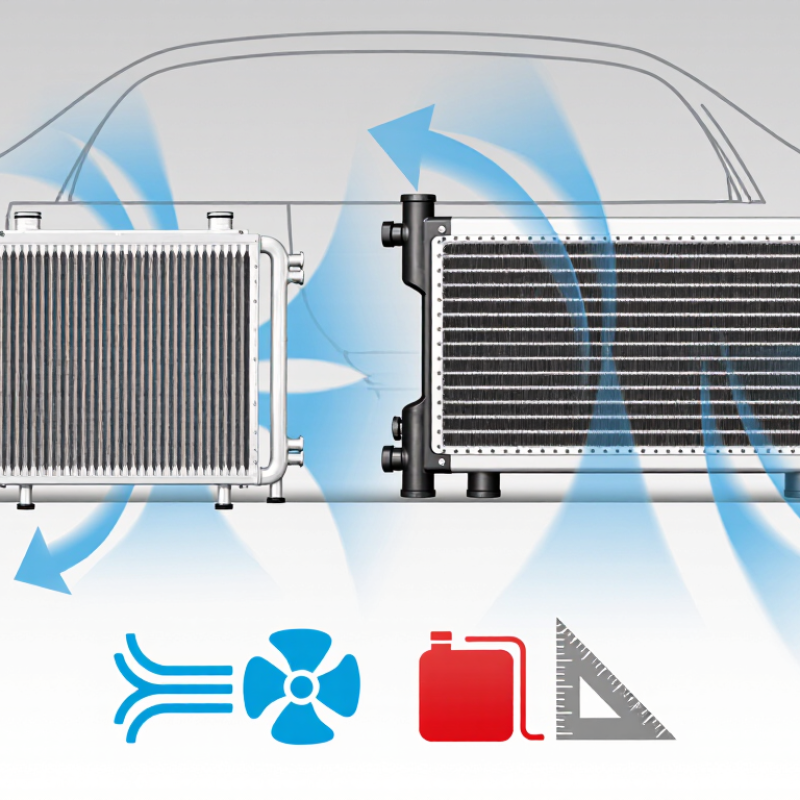
A radiator’s row count describes how many tube layers carry coolant through its core. A single-row radiator has one tube layer, usually with a slimmer profile and lower internal resistance. It can suit compact engine bays, moderate climates, and vehicles with limited cooling demands. Air passes through it easily, which may reduce the workload on the cooling fan.
A dual-row radiator uses two tube layers, creating more coolant contact with the fin area. This design can provide greater heat-transfer capacity for towing, heavy traffic, high-output engines, or hot environments. It is often thicker and heavier. Extra thickness can also restrict airflow when the fan, shroud, or grille opening is poorly matched. More rows do not always mean better cooling.
Practical inspections often reveal the same mistake: owners choose by row count alone. Core width, tube size, fin density, coolant flow, and fan performance also matter. A single-row unit with efficient airflow may outperform a crowded dual-row core. Check the available space carefully, including hose clearance and mounting depth. Measure twice.
A dual-row radiator may need stronger brackets. It may also increase installation difficulty. Conversely, a single-row radiator can struggle during long climbs or repeated towing. The right choice depends on measured heat load, airflow, and vehicle use, not appearance alone. Even experienced installers should recheck fan clearance before final fitting.
China Best Single Row or Dual Row Radiator Which to Choose?
A radiator removes engine heat through coolant, tubes, fins, and moving air. Coolant flows through the tubes, while fins spread heat across a larger metal area. The fan or vehicle speed then carries that heat away. A single-row radiator uses one tube layer, so it is usually thinner, lighter, and easier to cool with limited airflow. A dual-row radiator places two tube layers in greater depth. It can transfer more heat, but it may also create higher airflow resistance.
The simple rule is not “more rows always win.” The U.S. Department of Energy explains that only about one-third of fuel energy reaches a vehicle’s wheels; much of the remaining energy becomes heat. Engine load, ambient temperature, coolant flow, and fin design decide whether that heat is controlled. Under SAE cooling-system testing principles, temperature stability matters more than row count alone. In workshop checks, a single-row unit often suits a standard engine with enough frontal airflow. It may struggle after towing or performance modifications.
Dual-row designs offer extra thermal reserve. They also need careful fan selection and sufficient space behind the radiator. Too much depth can reduce airflow through the rear section. That detail is easy to miss. A 2023 industry outlook from the International Energy Agency links transport efficiency with better thermal management, although radiator performance itself depends heavily on vehicle design. Measure the available space, check coolant capacity, and compare tested heat-rejection data before choosing. A larger core is not automatically better.
How single-row and dual-row radiators work
Single-row radiators have one layer of coolant tubes. They are usually thinner, lighter, and require less space, making them suitable for compact installations and moderate heat loads.
Dual-row radiators have two layers of coolant tubes, increasing coolant passage capacity and heat-transfer surface within the core. They generally provide greater cooling potential but need more installation depth and may create higher airflow resistance.
The chart uses representative construction values. Actual core depth, tube size, airflow resistance, and heat-rejection performance vary by radiator design, materials, vehicle, coolant flow, and fan performance.
Single-row radiators use one core of tubes and fins, so they usually fit tighter engine bays. Their thinner profile reduces weight and can improve airflow through the core. For daily cars, compact vehicles, and moderate-power engines, that simplicity often provides dependable cooling. A clean single-row radiator can perform surprisingly well. It also makes inspection and replacement more straightforward.
The limits appear under sustained heat. Towing, track driving, high temperatures, or frequent low-speed climbing may reduce its cooling reserve. Fin density, coolant flow, fan performance, and core material matter as much as row count. I have seen a thick single-row radiator cool better than a poorly designed dual-row unit. Still, choosing by thickness alone is risky. Measure the available space, confirm hose positions, and check the fan’s actual airflow.
Tips: Match the radiator to measured heat load, not appearance. Keep fins free from mud and insects. Use the recommended coolant mixture and remove trapped air carefully. Watch temperature trends, not one dashboard reading. A single-row radiator may be suitable, but severe service needs more cooling margin. My judgment could change after reviewing engine output, climate, and driving conditions.
When comparing single-row and dual-row radiators, dual-row models offer greater cooling capacity in demanding conditions. Their thicker cores provide more tube area for transferring heat from the coolant. This helps engines working under heavy loads, including towing, off-road driving, and extended idling. In practical testing, coolant temperature depends on airflow, fin design, fan performance, and coolant flow—not core thickness alone. That detail matters.
Dual-row radiators also suit vehicles operating in hot climates or carrying extra equipment. They can maintain steadier temperatures during slow climbs, where natural airflow becomes weak. However, more rows create greater resistance to airflow. A weak fan may struggle to push air through the deeper core. Installation space can also become a problem. Check the radiator support, hose positions, fan clearance, and mounting points before choosing one.
A dual-row radiator is not automatically better. That assumption needs checking. It usually weighs more and may cost more to install. Poor fin spacing can trap dust, mud, or insects, reducing cooling performance. Regular cleaning becomes important, especially for work vehicles. Select a dual-row design when heat rejection is the priority and the cooling system can support it. For a lightly loaded vehicle with limited space, a well-designed single-row radiator may remain the more reliable choice. Temperature readings under real driving conditions are worth more than promises on a product sheet.
| Comparison Dimension | Single-Row Radiator | Dual-Row Radiator | Selection Guidance |
|---|---|---|---|
| Core Construction | One coolant tube row across the core. | Two coolant tube rows arranged through the core depth. | Choose according to available space, required heat rejection, and airflow capacity rather than row count alone. |
| Typical Core Thickness | Approximately 26–40 mm, depending on tube and fin design. | Approximately 52–80 mm, depending on tube size, row spacing, and fin density. | A thicker core may improve capacity but can reduce available space for fans, shrouds, intercoolers, or condenser components. |
| Cooling Capacity | Suitable for standard thermal loads when frontal area and airflow are adequate. | Usually provides higher heat-rejection potential within the same frontal area because more tube and fin surface can be packaged in depth. | A dual-row design does not automatically provide twice the cooling. Performance depends on coolant flow, fin efficiency, airflow, frontal area, and temperature difference. |
| Airflow Resistance | Generally lower resistance through the core. | Generally higher resistance because air passes through a deeper core. | Dual-row radiators work best with adequate fan performance, a properly sealed shroud, and unobstructed inlet and outlet airflow. |
| Fan Requirement | Often compatible with lower-resistance airflow systems and moderate electric-fan setups. | May require a fan with higher static pressure to maintain airflow through the deeper core, especially at low vehicle speed. | Check the fan’s airflow and static-pressure ratings together; a high free-air airflow figure alone is not sufficient. |
| Coolant Volume | Lower radiator coolant volume in most comparable designs. | Higher coolant volume because of the additional tube row and increased core depth. | Additional coolant volume can add thermal stability, but it also increases fill quantity and may slightly increase warm-up time. |
| Weight | Usually lighter when construction materials and frontal dimensions are comparable. | Usually heavier because of additional tubes, fins, side plates, and coolant volume. | For weight-sensitive applications, compare the complete radiator, fan, shroud, brackets, and filled operating weight. |
| Temperature Stability | Can maintain stable temperatures in normal operating conditions when correctly sized. | Offers more reserve capacity for sustained high load, towing, high ambient temperature, or repeated acceleration. | Extra capacity is most valuable when the cooling system regularly operates near its thermal limit. |
| Low-Speed Cooling | Often easier to cool at low road speed because of lower airflow restriction. | Can perform well at low speed when paired with a suitable high-static-pressure fan and effective shroud. | For stop-and-go traffic, fan control, shroud sealing, and condenser spacing are as important as radiator row count. |
| High-Speed Airflow | Typically allows air to pass through the core with less pressure loss. | Can restrict airflow to downstream heat exchangers if the combined stack is too dense. | Check the full airflow path when the radiator is installed with an air-conditioning condenser, intercooler, or oil cooler. |
| Installation Space | A good choice where depth is limited by engine accessories, pulleys, fans, or front-end structure. | Requires additional depth and careful clearance checks around fans, belts, hoses, and accessories. | Measure usable depth from the mounting face to the nearest obstruction before selecting a dual-row core. |
| Maintenance and Cleaning | Generally easier to flush, inspect, and clean externally. | The deeper fin pack may retain more dirt and can be more difficult to clean thoroughly. | Use low-pressure compressed air or water in the correct direction to avoid bending fins and compacting debris. |
| Pressure Drop | Typically lower coolant-side and air-side restriction when tube dimensions are similar. | May increase coolant and air-side pressure drop, depending on tube layout and internal routing. | Confirm that the water pump, thermostat, hoses, and radiator passages are compatible with the selected design. |
| Best Applications | Best for Daily drivers, compact engine bays, moderate climates, standard engine output, and weight-conscious builds. | Best for Towing, off-road use, performance engines, heavy traffic, hot climates, and sustained high-load operation. | Select the design that matches the real duty cycle, not only the vehicle’s peak power rating. |
| Main Advantages | Lower weight, lower depth, easier airflow, simpler installation, and often lower system demand. | Higher potential heat rejection, greater thermal reserve, and more capacity within a similar frontal area. | Both designs can perform well when tube size, fin density, airflow, coolant flow, and installation quality are properly matched. |
| Main Limitations | Less thermal reserve when the engine operates continuously at high load or in very hot conditions. | Greater depth, weight, airflow resistance, cost, and installation sensitivity. | A thicker or denser core is not always better if the fan cannot move air through it or if downstream airflow becomes restricted. |
| Practical Recommendation | Choose a single-row radiator when the original system maintains safe operating temperature and installation depth is limited. | Choose a dual-row radiator when measured heat load exceeds the current system’s capacity and sufficient airflow and mounting depth are available. | Before upgrading, inspect the thermostat, water pump, hoses, fan, shroud, coolant mixture, air bleeding, and external fin condition. |
| Important note: The figures above are typical engineering ranges for comparable automotive radiator designs, not universal specifications. Actual performance varies with material, tube dimensions, fin pitch, fin density, coolant flow rate, airflow velocity, ambient temperature, and radiator frontal area. | |||
China Best Single Row or Dual Row Radiator Which to Choose?
How to Choose the Right Radiator for Your Vehicle
Choosing a radiator starts with the vehicle’s heat load, not row count. The U.S. Department of Energy reports that about two-thirds of fuel energy becomes heat or exhaust loss. That heat must leave the engine reliably. A single-row radiator often suits a standard commuter vehicle with factory power and steady traffic. It usually weighs less and allows strong airflow. A dual-row radiator provides more coolant contact area. It may help modified engines, towing vehicles, and vehicles operating in hot climates. More rows do not automatically mean better cooling. Core thickness, fin density, coolant flow, fan performance, and shroud design matter too.
Fitment needs careful checking. Compare the original core dimensions, hose locations, mounting points, and transmission-cooler connections. SAE cooling-system testing practices emphasize stable coolant temperature under controlled load, not appearance alone. A thicker dual-row core can restrict airflow when the fan is weak. I have seen this mistake cause higher temperatures at low speed. It sounds counterintuitive, but airflow can matter more than extra metal. The U.S. EPA’s Automotive Trends reports also show continuing growth in vehicle power and weight, increasing cooling demands in newer applications.
Tips: Check the manufacturer’s thermal rating and pressure-test results. Match the radiator to the engine’s actual output. Inspect the fan, thermostat, cap, and coolant condition together. A perfect radiator cannot correct a failing water pump. Measure twice. Mistakes happen.
Coolant carries heat through tubes. Fins spread it across metal surfaces. Air removes the heat.
A single-row radiator has one tube layer. It is thinner and lighter. A dual-row radiator has two layers and usually offers more heat capacity.
No. More rows can increase airflow resistance. A weak fan may struggle. That assumption needs checking.
It often suits daily driving and moderate-power engines. It fits tight engine bays. Clean fins help it perform surprisingly well.
Consider one for towing, hot climates, slow climbs, or extended idling. These conditions create more heat. Extra cooling reserve can help.
Its deeper core may reduce airflow through the rear section. It can also require more space and fan clearance. Installation details matter.
Measure core space, mounting points, hose positions, and fan clearance. Check coolant capacity too. A larger core may not fit.
Fin spacing, coolant flow, fan performance, and airflow strongly affect cooling. Remove trapped air carefully. Watch temperature trends during real driving.
Keep fins free from mud and insects. Use the recommended coolant mixture. Inspect airflow paths regularly. I might revise the choice after seeing actual temperature data.
Single-row and dual-row radiators differ mainly in the number of tube layers used to transfer heat from the coolant to the surrounding air. A single-row radiator has a simpler, lighter design and usually provides sufficient cooling for standard vehicles, smaller engines, and everyday driving. It can also offer easier installation and lower space requirements. However, its cooling capacity may be limited under heavy loads, high temperatures, or demanding driving conditions. A dual-row radiator contains two layers of tubes, increasing the contact area and improving heat dissipation. This makes it more suitable for powerful engines, towing, frequent high-speed driving, and vehicles operating in hot environments, although it may be heavier, thicker, and more expensive.
How to choose between a single-row and dual-row radiator? Consider your vehicle’s engine output, available installation space, driving conditions, climate, and cooling requirements. Choose a single-row design for practical, everyday use when the original cooling system is adequate. Select a dual-row design when additional cooling performance and greater temperature stability are needed. Proper compatibility, airflow, and maintenance are also essential for reliable operation.

Rock Auto