5 Best Benefits of Brazed vs Plastic Tank Radiators?

Time:2026-10-16 Author:Liam
0%

Choosing the right radiator affects cooling performance, service life, and operating confidence. In daily workshop experience, the difference becomes visible under heat, vibration, and repeated pressure cycles. A brazed radiator may provide stronger joints and improved resistance to demanding thermal conditions. A plastic tank radiator may offer lower purchase costs and useful vibration flexibility.

What are the benefits of brazed vs. plastic tank radiators? This question deserves more than a simple durability claim. Brazed designs commonly use aluminum cores and tanks joined through controlled furnace brazing. Their bonded seams can reduce weak points around the cooling passages. They may also support efficient heat transfer, compact packaging, and better resistance to high-temperature stress. However, performance depends on fin density, coolant flow, manufacturing quality, and correct installation.

Plastic tank radiators remain practical in many passenger vehicles. Their molded tanks can reduce weight and production expense. They may tolerate certain movement between the radiator and vehicle structure. That advantage should not be ignored.

The real comparison is application-based. A heavy-duty truck, modified vehicle, and everyday commuter face different cooling demands. Five benefits may favor brazed construction, but none should replace inspection, testing, and manufacturer specifications. A brazed radiator can still fail from corrosion, impact, poor airflow, or neglected coolant. This is where reflection matters. Stronger construction does not mean unlimited service life.

This guide examines the main advantages of brazed radiators against plastic tank alternatives. It considers durability, thermal performance, repair expectations, weight, and long-term value. The goal is a balanced decision based on evidence, operating conditions, and practical maintenance experience.

5 Best Benefits of Brazed vs Plastic Tank Radiators?

Construction Benchmark: Brazed Aluminum Cores vs. PA66-GF30 Plastic Tanks

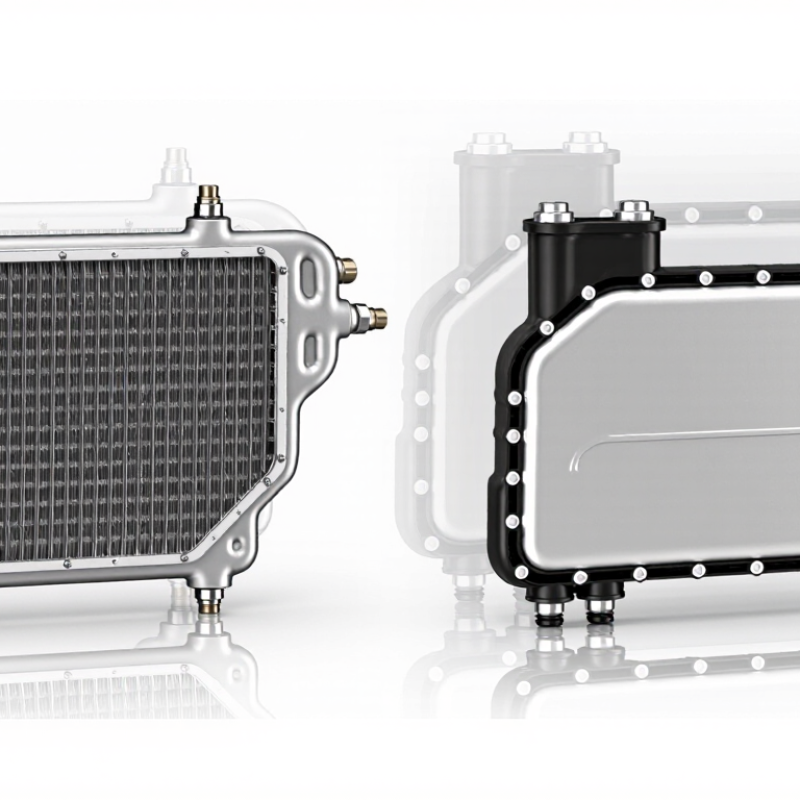
Brazed aluminum cores and PA66-GF30 plastic tanks create different radiator performance profiles. The brazed core joins aluminum layers under controlled heat, reducing seams and improving heat transfer across the fin pack. Aluminum also keeps weight low, which helps vehicles manage front-end load. Its rigid structure can resist pressure changes and vibration when the assembly is properly supported. The fifth benefit is packaging flexibility. Thin brazed cores can fit narrow engine compartments. However, brazed construction is not automatically better. Poor brazing, blocked airflow, or weak mounting can still cause early failure.

The PA66-GF30 tank adds glass fiber for stiffness and dimensional stability. It handles engine-bay heat while reducing production cost and weight. Its molded shape can integrate outlets, brackets, and sensor ports efficiently. The tank also works well with crimped seals and replaceable service components. In field inspections, cracks often appear near hose necks, corners, or mounting points after repeated thermal cycling. That detail matters more than a material label. Plastic may age gradually, while a damaged brazed core can lose coolant suddenly. No design wins every test.

Tips: Compare burst pressure, thermal-cycle data, vibration results, and gasket quality. Check the tank’s neck thickness and the core’s braze coverage. Do not judge durability by appearance alone. A slightly heavier radiator may survive real-world movement better. Test the complete assembly, not only the aluminum core.

Heat Transfer: Aluminum Conductivity ~205 W/m·K vs. PA66-GF30 ~0.3 W/m·K

5 Best Benefits of Brazed vs Plastic Tank Radiators?

Heat transfer begins with material conductivity. Aluminum conducts heat at approximately 205 W/m·K, while PA66-GF30 is around 0.3 W/m·K. That difference is substantial. Brazed aluminum tanks and cores can spread heat quickly across thin passages and fins. This helps move coolant heat into the airflow, especially when space is limited or engine loads rise.

Plastic tanks mainly provide a lightweight, corrosion-resistant housing. In many radiators, the core remains aluminum, so the coolant still reaches a conductive metal structure. However, the plastic tank does not distribute heat efficiently. Brazed joints also create a compact, rigid assembly with fewer mechanical seams. This can improve vibration resistance, though poor brazing, thermal cycling, or impact damage may still cause leaks. Material numbers alone do not decide performance. Fin density, coolant flow, airflow, and surface area matter too.

Tips: Check the core design, not only the tank material. Inspect brazed areas for uneven fillets or discoloration. For plastic tanks, examine crimped edges and gasket compression. Keep coolant chemistry controlled, because corrosion can quietly reduce passage thickness. A higher conductivity value sounds decisive, but real-world cooling tests sometimes reveal a smaller advantage than expected. That is worth questioning.

Temperature Durability: Brazed Aluminum Melts at 577–660°C; PA66 Service Near 120–150°C

Brazed aluminum radiators offer five practical advantages over plastic-tank designs: higher temperature tolerance, lighter construction, compact packaging, stronger joints, and efficient heat transfer.

ASM Handbook data places common aluminum brazing alloys around 577–660°C for their solidus-to-liquidus range. This is far above normal coolant temperatures. However, the entire radiator does not safely operate near its melting range. Seals, fins, tubes, and coolant chemistry still limit durability.

Plastic tanks commonly use glass-filled PA66. Engineering data referenced in UL 746B thermal-aging evaluations often places continuous service near 120–150°C, depending on grade, load, moisture, and exposure time. That range can be adequate for ordinary vehicles.

Repeated heat cycling may still cause warping, creep, or cracks around hose necks. Brazed aluminum avoids many polymer creep concerns and maintains rigid geometry under pressure. It also transfers heat quickly through thin metal walls. That supports smaller cores. A useful benefit, though sometimes overstated.

Tips: Check peak coolant temperature, pressure pulses, vibration, and thermal-cycle data before choosing a radiator. Do not compare melting point alone. Measure the tank, joint, seal, and mounting temperatures together.

In field inspections, whitening near plastic outlets or small coolant stains often appear before complete failure. The honest caveat is simple: brazed aluminum is not automatically better. Poor brazing, galvanic corrosion, or weak mounting can erase its temperature advantage.

Weight and Packaging: Aluminum Density 2.70 vs. PA66-GF30 About 1.35 g/cm³

Brazed aluminum and plastic-tank radiators make different packaging trade-offs. Aluminum has a density of about 2.70 g/cm³, while PA66-GF30 is near 1.35 g/cm³. At equal volume, aluminum weighs roughly twice as much. However, a radiator is not a solid block. Its tubes, fins, headers, tanks, coolant, and mounting brackets determine the final mass.

Plastic tanks can reduce weight around the side chambers and allow complex shapes near crowded engine components. This flexibility may improve hose routing and create extra clearance. Brazed aluminum construction can offer thin, rigid passages and strong heat-transfer performance. It also supports compact cores when designers control wall thickness carefully. The comparison is not perfectly clean. Material density alone does not predict the complete radiator weight. I have seen packaging studies change after brackets and vibration supports were added.

Tips: Compare complete assemblies, not isolated materials. Measure dry weight, filled weight, and installation space. Check tank deformation near hose connections. A lighter component may still need thicker supports. Leave room for thermal expansion and service access. Small errors matter.

Use a simple packaging model before selecting the design. Record core dimensions, tank depth, hose angles, and nearby clearances. Then verify the model with a physical mock-up. This step often exposes an uncomfortable truth: the lightest material may not create the lightest system. Cost, durability, assembly method, and repair expectations should remain part of the engineering decision.

5 Best Benefits of Brazed vs. Plastic Tank Radiators — Weight and Packaging: Aluminum Density 2.70 vs. PA66-GF30 About 1.35 g/cm³

Benefit / Design Dimension Brazed Aluminum Tank PA66-GF30 Plastic Tank Practical Engineering Impact
1. Packaging Efficiency Aluminum tank walls can commonly be designed in thinner sections, often approximately 1.0–2.0 mm, depending on geometry, alloy, forming method, and pressure requirements. Injection-molded glass-fiber-reinforced polyamide tanks commonly use thicker sections, often approximately 2.5–4.0 mm, to manage stiffness, creep, weld lines, and local loads. Brazed aluminum can provide more compact tank geometry and greater packaging freedom, although the final result depends on the complete radiator design rather than wall thickness alone.
2. Material Density and Weight Typical aluminum density: 2.70 g/cm³. At the same material volume, aluminum weighs approximately twice as much as PA66-GF30. Typical PA66-GF30 density: approximately 1.35–1.45 g/cm³, depending on glass-fiber content, additives, moisture, and grade. Plastic has the density advantage at equal volume. However, the complete brazed radiator may still be competitive in weight because aluminum can use thinner walls and fewer separate attachment features.
3. Thermal Conductivity Aluminum thermal conductivity is typically about 205–235 W/m·K, depending on alloy and temper. PA66-GF30 is typically about 0.3–0.5 W/m·K, depending on fiber orientation, moisture, and formulation. Aluminum conducts heat hundreds of times more effectively, supporting faster heat spreading through metallic tank sections. The direct cooling benefit depends on whether the tank is part of the active heat-transfer path.
4. Temperature and Pressure Robustness Aluminum retains useful stiffness at temperatures well above normal coolant operating conditions, while brazed joints can form a continuous, leak-tight metallic structure when properly designed and manufactured. PA66-GF30 performance is more sensitive to temperature, moisture absorption, glass-fiber orientation, weld-line quality, and long-term creep. Typical continuous-use limits are grade-specific and commonly fall near the 120–150°C range. Brazed aluminum generally offers a wider thermal and pressure-design margin, particularly for high-temperature cycles and severe under-hood environments.
5. Durability and End-of-Life Value Aluminum provides a durable metallic structure and has a well-established recycling stream. Brazed assemblies can also reduce the number of separate mechanical joints. PA66-GF30 offers good corrosion resistance and low density, but long-term durability can be affected by thermal cycling, coolant exposure, vibration, moisture, and polymer creep. Recycling requires handling of the polymer-glass composite. Brazed aluminum is often preferred where service life, dimensional stability, recyclability, and resistance to repeated thermal cycling are high priorities.
Engineering note: Values shown are representative ranges for material comparison, not universal product specifications. Actual radiator mass, pressure rating, wall thickness, thermal performance, and service life depend on alloy or resin grade, geometry, joining method, coolant, temperature cycle, vibration, and validation testing.

Durability Testing: Compare Brazed Joints Under SAE J1645 and ISO 16750 Standards

5 Best Benefits of Brazed vs Plastic Tank Radiators?

Brazed radiators join the core and tank with a continuous metal seam. Plastic tank radiators usually depend on crimped seals and elastomer gaskets. That difference matters during pressure cycling. SAE J1645 evaluates radiator performance through heat rejection, pressure, vibration, and leakage checks. A brazed joint can resist repeated thermal expansion more consistently, especially around narrow tubes and header plates. Plastic designs remain lighter and cheaper. They can also absorb minor impacts without denting.

Durability testing should follow a controlled sequence. Under SAE J1645, technicians should record coolant pressure, inlet temperature, outlet temperature, and leakage after each cycle. ISO 16750-4 adds environmental stress, including temperature cycling, humidity, vibration, and mechanical shock. Test profiles may reach about -40°C to 85°C, depending on component location and vehicle class. A pressure trace is useful. A small leak may appear only after the fifth or sixth cycle.

Brazed joints often show cleaner failure patterns during teardown. Cracks are visible. Gasket compression loss is less predictable in plastic tanks. However, brazing is not automatically superior. Poor furnace control can create brittle areas or incomplete bonding. That point deserves more attention. Independent laboratory reports should include sample size, coolant type, pressure level, cycle count, and post-test microscopy. Without those details, a “passed” result says very little. Real workshop inspections also matter, because road salt, trapped air, and incorrect coolant can distort laboratory comparisons.

FAQS

What is the main construction difference between brazed aluminum cores and plastic tanks?

Brazed aluminum parts join under controlled heat, creating continuous metal seams. Plastic tanks usually use crimped seals and elastomer gaskets. The construction changes leakage behavior.

Which material transfers heat more efficiently?

Aluminum conducts heat at about 205 W/m·K. PA66-GF30 conducts roughly 0.3 W/m·K. That gap is substantial. However, fin density, coolant flow, and airflow also control cooling performance.

Why can a brazed aluminum radiator fit tight engine spaces?

Thin brazed cores can provide useful cooling within narrow compartments. Their rigid structure also supports compact passages and fins. Space savings matter.

What benefits does PA66-GF30 offer?

Glass fiber improves stiffness and dimensional stability. Molded plastic can combine outlets, brackets, and sensor ports. It may also reduce production cost and overall weight.

Where do plastic tanks commonly develop cracks?

Cracks often appear near hose necks, corners, and mounting points. Repeated heating and cooling can stress these areas. Inspect them closely.

Can brazed aluminum construction fail early?

Yes. Poor brazing, blocked airflow, weak mounting, or impact damage can cause early failure. Uneven brazing marks may indicate incomplete bonding. Stronger is not guaranteed.

How should radiator durability be tested?

Test the complete assembly through pressure, heat, vibration, humidity, and mechanical shock cycles. Record temperatures, pressure, leakage, and cycle counts. Test everything.

What inspection details matter before choosing a radiator design?

Check burst pressure, gasket compression, braze coverage, neck thickness, and mounting strength. Inspect coolant passages for corrosion. Do not judge durability by appearance alone. A slightly heavier unit may survive road movement better. That conclusion may still be incomplete.

Conclusion

What are the benefits of brazed vs. plastic tank radiators? Brazed aluminum radiators offer a strong balance of thermal performance, durability, weight, and packaging flexibility. Aluminum cores conduct heat at approximately 205 W/m·K, far exceeding the roughly 0.3 W/m·K conductivity of PA66-GF30 plastic tanks, helping transfer heat more efficiently through the radiator assembly. Their brazed construction also provides durable joints and supports compact designs where space and cooling demand are limited.

Temperature resistance is another major advantage. Brazed aluminum can withstand far higher temperatures, with melting points around 577–660°C, while PA66-GF30 typically operates near 120–150°C. Aluminum is denser at about 2.70 g/cm³, compared with approximately 1.35 g/cm³ for PA66-GF30, but its strength can enable thinner, lighter structural designs. Durability should be verified through testing of brazed joints under standards such as SAE J1645 and ISO 16750, ensuring dependable performance under vibration, thermal cycling, and demanding operating conditions.

Liam

Liam

Liam is a dedicated marketing professional with a profound expertise in the industry, where he excels at highlighting the unique advantages of our core products. With a keen understanding of market trends and consumer needs, Liam frequently updates our company’s professional blog, providing......